
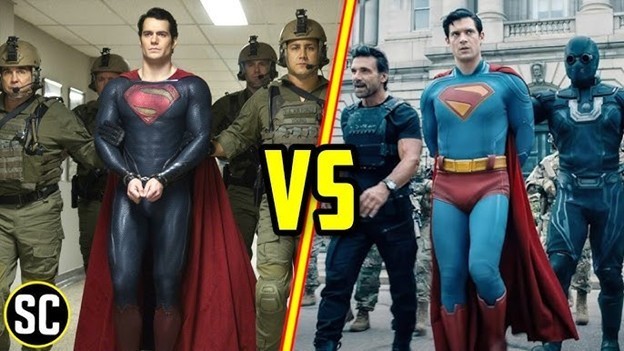
Superman has always been more than just a superhero. Despite his alien blood, he shares our qualities of kindness and compassion, making him just as human. For decades, audiences have expected him to be a beacon of hope, someone who fights not only villains but also despair itself. The newest Superman film, featuring David Corenswet, rises to that expectation with a brighter, more compassionate version of the Man of Steel, one who feels deeply connected to the people he protects. It’s a sharp contrast to Henry Cavill’s brooding 2013 portrayal in Man of Steel, where Superman’s dark suit and distant demeanor reflected a grimmer era. This return to a hopeful Superman doesn’t just reimagine the character, it reminds us why he mattered in the first place.
Where Man of Steel emphasized Superman’s struggle to fit in, this film emphasizes his choice to belong. Directed by James Gunn, the movie opens not with destruction or inner turmoil but with small, human moments: Clark Kent helping rebuild his hometown, speaking to children, and finding joy in the world he’s sworn to protect. The tone feels lighter, but not shallow; the cinematography and storytelling are infused with empathy. In a time when most superhero films lean into cynicism and spectacle, this Superman stands out for his humanity.
That shift back to optimism resonated with many viewers. Sam Franco, a Co-op senior, said, “I didn’t like how they portrayed Superman in the Henry Cavill films. They took away that sense of hope and made him a nitty gritty, super angry guy.” His reaction captures a common frustration with Cavill’s version. He is a Superman who often seemed more alien than inspirational. Franco added: “His costume was like entirely black, he did not look like a superhero at first. I thought it was going to be an evil Superman movie.” The new film seems almost designed to answer that criticism, restoring Superman’s iconic bright colors and moral clarity.
One of the film’s greatest strengths lies in its balance between nostalgia and relevance. The new red-and-blue suit gleams with color, symbolizing a return to the optimism that defined early comic book heroes. Yet, it doesn’t ignore modern complexity because this Superman isn’t naïve. He still faces moral dilemmas and loss, but his compassion leads the story – not his anger. That’s what separates him from Cavill’s interpretation, which, while visually striking, often felt emotionally distant. Cavill’s Superman reflected a post-9/11 world uncertain about goodness; the new version reflects a generation craving hope in chaos.
Still, not everyone agrees that the lighter tone is better. Some fans argue that Cavill’s darker Superman felt more realistic, showing how even the most powerful being could struggle with morality and purpose. To them, his darker suit and emotional distance symbolized a hero shaped by trauma. It was a reflection of modern audiences who see the world in shades of gray, not simple good and evil. In that sense, the darker Superman may speak to those who find comfort in imperfection rather than idealism.
But for most viewers, the latest Superman feels like a breath of fresh air. It reclaims the heart of a cultural icon and reminds audiences that strength and kindness can coexist. As the credits roll, a quiet image appears. Superman is standing among ordinary people, with his cape flowing softly behind him. I love how this ending scene captures the film’s message best: true power doesn’t come from distance, but connection. And maybe, in a world constantly searching for hope, that’s the hero we’ve been waiting for. We can all learn something from Superman.