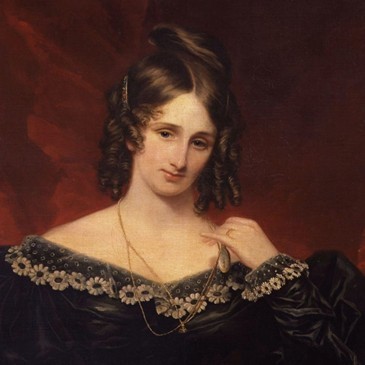
Mary Shelley never set out to become the mother of science fiction. She didn’t imagine that a story sparked by a rainy summer day and a writing challenge among her friends would outlive her. That it would be rewritten through centuries of adaptations and put her at the center of debates on creation, responsibility, and humanity. When she wrote Frankenstein, she was only 20 years old. Newly married and navigating a life that was dominated by rebellion, scandal, and rejection. From her own challenging experiences emerged one of literature's most enduring stories.
Born Mary Wollstonecraft Godwin, she entered life with a legacy of both power and tragedy laid before her. Her mother, the revolutionary feminist writer Mary Wollstonecraft, died shortly after childbirth. Her father, William Godwin, eventually remarried, but Mary never found a strong maternal figure. Instead, she found her home in books, ideas, and the intellectual visitors who passed through her father’s house constantly. She received almost no formal education, but she absorbed the conversations about politics, philosophy, and literature happening around her with hunger. Her mind was not shaped by classrooms but by arguments around dinner tables, shelves full of radical texts, and a childhood surrounded by thinkers who questioned any and everything.
That questioning spirit stayed with her. When I spoke with English teacher Marialuisa Sapienza, she described Mary Shelley as “a kind of rebel we see today — someone using her art to pass along criticism and message.” Sapienza noted that Shelley grew up in a time when writers often used literature to critique the political class and the rising inequalities of early industrial England. “Some people were emerging as wealthy based on the exploitation of others,” she explained. “That was essentially her take”
Rebellion drew the young Mary toward Percy Bysshe Shelley, a married poet whose radical ideals matched her own desire for an escape. At sixteen she ran off with him, an act considered scandalous and reckless by society. But Mary’s choice reflected her independence more than her impulsiveness. She wanted a life of ideas, not of constraints. What she did not anticipate was the emotional cost. The death of her first child, financial instability, and the stress of loving a man that was publicly loved but was inconsistent in private burdened her mind constantly.
Still, she wrote. She read. She listened. And in 1816, during the famous “Year without a Summer,” she traveled to Lake Geneva with Percy Shelly, Lord Byron, and her stepsister Claire Clairmont. Trapped indoors by relentless rain, the group entertained themselves with discussions about science, reanimation, philosophy, and the boundaries of knowledge. When Byron proposed a competition to write a ghost story, Mary struggled for days. Until she experienced what she later called a “waking dream”: a scientist kneeling over a creature he had assembled from dead parts, horrified by the life he had created.
From that image came Frankenstein.
When asked what themes best reveal who Mary Shelley was, Sapienza pointed to the novel’s psychological depth. “People really have this double personality,” she said. “The way you feel inside, you project outside. The monster is the monster you have inside, and she projected it outside – and then everybody hated it.” She emphasized two important themes: the pain of being rejected for being different, and the fear of not belonging to the norm. According to Sapienza, those ideas mirror Mary Shelley’s own insecurities being a young woman writer in a male dominated world, often dismissed, misunderstood, or overshadowed.
These insecurities were not imagined. Mary Shelley faced challenges that most of her male peers never had to consider. “Women were not allowed to attend any college,” Sapienza explained. “The challenge was just being able to publish her work, to have it out… there was this kind of rejection.” She compared Mary Shelley’s struggle to obstacles women still face today, noting how society continues to treat women’s minds as inferior or less authoritative.
Yet despite this, Mary Shelley pushed through. What helped her, Sapienza argued, was that she grew up “lucky to have a library… and group discussions with other writers,” even if most were men. Education, for her, happened at home – in conversations, in reading, in listening. She also had the influence of Percy Shelley whom Sapienza referred to as “the husband, the poet,” highlighting how his work, like Ozymandias, shared Mary’s critical voice toward power and inequality.
Despite her struggles, Mary Shelley was resilient. After Percy died in 1822, she returned to England with their only surviving child and committed herself to preserving his legacy, editing and publishing his works. At the same time, she continued writing novels that explored history, politics, plague, and survival. The Last Man, a dystopian novel about a world destroyed by disease, revealed her deep grief and her ability to imagine futures far beyond her own time.
When asked what students are most surprised to learn about Mary Shelley, Sapienza said the real issue isn’t surprise — its context. “Today’s students don’t always have enough historical or biographical background,” she explained. But she believes that if they did, they would see how deeply Frankenstein reflects Mary Shelley’s own sense of inferiority and rejection. “She feels inferior because she’s seen as a ‘monster’; she’s a woman and she’s a writer”.
Mary Shelley died in 1851 at the age of 53, likely from a brain tumor. For years, she was remembered primarily as Percy Shelley’s widow. But time has restored her identity. Today, she stands not behind the men she loved, but beside them — and in many ways, farther ahead.
Her legacy is not just one brilliant novel, but a lifelong struggle to assert her voice in a world that tried to silence it. She understood what it meant to create, to mourn, to be rejected, and to keep going anyway. And in that sense, the most human part of Frankenstein is not the monster or the scientist. It is Mary Shelley herself, a woman that turned her own fears and insecurities into a story that still refuses to die.