
RBF of Crest Toothpaste Commercial?
By: Nadia Okwuosa
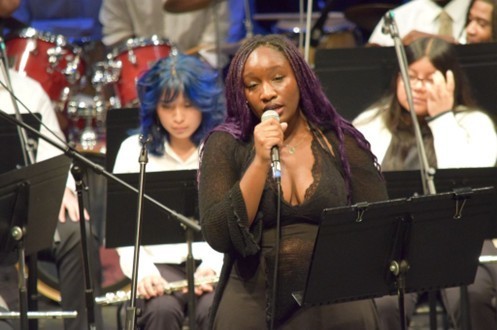
Since the age of 5 years old, if not younger, I have always had a “Resting Bitch Face”. No, my parents weren’t un-expressive psychopaths. No, I wasn't raised in rooms with dark, unstimulating colors. I guess it was just who I was. But this instant perception has always haunted me. To this day, teachers question if I'm sad or angry. Friends say I look mean, scary, or just unapproachable. But on the inside, I wanted to connect with people. I wanted people to look past that and still approach me anyway. So I figured I’d still try to be noticed. Everyday I remind myself to smile when I'm walking through the hallways. Sometimes I feel like I'm in a crest toothpaste commercial but it's worth it. It’s worth having people feel like they can talk to me and be my friend. Throughout this study, I’ve learned that oftentimes, the way people perceive us may feel like a restriction on who we want to be, but it is our jobs to express ourselves beyond those preconceived notions and show people who we truly are.
I think we’ve all experienced that one conversation with your friends, when you ask the question, “What did you think of me when you first saw me”. To me, this question has been the biggest indicator of true friendships I've made throughout my life. I interviewed my friend Fallon Williams, who I've grown close with since sophomore year. When I asked her this question she said, “Oh I was scared! I did think you were very cool though. You had a presence, the way you walked in the room and the way you carried yourself, you seemed very sure”.
I then asked what were the things that made me unapproachable? She said, “Oh, your RBF! It's done nothing but get worse (jokingly) but your RBF was also scary then! I mean there's not much you can do about it but like, if looks could kill, I would be dead!”. Now Fallon may be sugar coating some things, but what she said is what I've been told my whole life. People always expected me to be mean. I may have been admired for my way of dressing and confidence, but it seems that because of my RBF, people had a hard time approaching me to be friends. But were they right in their assumption of me?
Naturally humans can misinterpret others based on their body language.
Once in a while you may see those 5 minute Youtube videos on “How to spot a Liar” but a lot of the interpretations they give are actually myths. On another Youtube video, a former FBI agent, Joe Navarro, explains how to correctly read body language while debunking those myths. One of the common physical behaviors is crossing your arms. Many would see this as being uninterested, distant, or blocking off. However, this behavior is actually used, even if you're talking to someone you like (Navarro).
Another example of these behaviors is looking around after being asked a question. This actually involves processing the information. Many think that it is indicative of deception which is not always true (Navarro). These behaviors are things that we all do, especially when we are talking to other people. We use these body languages to emotionally and physically regulate our bodies. Using different ways of expression to process what we are thinking and feeling are also often time done unconsciously. For me, my “Resting Bitch Face” is actually a tactic too. I tend to dissociate a lot, causing me to be unaware of how my face looks at all times. And to be completely honest dissociation is how I get through a boring, long day at school.
On the contrary, teachers were surprised by how well I spoke and guided conversations. One year during a geometry class with former Co-op teacher, Ms. Lerew, she overheard a conversation I was having with my friends about our math work. I had answered a couple of the math questions for my friend and then asked him if he would like to try some on his own now. Ms. Lerew began to praise me on how I conducted that conversation. She seemed surprised and stopped to thank me in front of the whole class.
This reaction from her began to happen multiple times throughout the year. After sending her an email, or just giving her an appropriate response, she praised me for my “proper” use of language. This wasn't the first time a teacher had done this. My whole life I was considered a good student because I was always respectful and spoke only when spoken to. This was the type of behavior that was praised. But it seems that the only thing they noticed about me was my politeness. Was it because I was a black girl? Who some may expect to be uneducated, angry, and loud? So when Ms. Lerew saw me as the exact opposite of that, she deemed me not just a good student, but a good black student. At that moment, my identity was chosen for me.
At times it may feel like a constant fight, battling what society wants you to be and wanting to prove that you are more than who they want you to be. We may even feel safer to adhere to these perceptions. If we play the role, we get the part, and we are accepted as who they prefer us to be. In an article titled, “The Burden of Code Switching” by Susan Hutton, the author dives into an analysis of different ways people code switch. When we interact with people, especially those from a different background or identity, we intuitively try to figure out how to fit in and find common ground (Hutton). Many times I found myself in the situation, especially when being in predominantly white spaces. It is our natural instinct to be liked and to want to be common with other people. But at times, this commonality is needed to find safety and survival. As a black person being in white spaces means adapting to the way they speak, act, and even look sometimes. But the exchange for a performed identity for validation is not worth the cost of our right to be ourselves.
As I've gotten older, I've tried to fit in, no matter the type of environment. But I always made sure to show more of who I actually am. For awhile I resented people for their perception of me. I thought it wasn't fair because I was really just trying to be comfortable in myself . I could never really tell that I looked like a bitch! But I still wanted people to be more curious about me. I felt that it was their responsibility to look past what I showed on the outside. Never judge a book by its cover right? But as I felt this way, I started to wonder, wasn't I scared too?
I now realize that I too hold the responsibility of initiating conversations with others and looking beyond my own perceptions of other people. I can also choose to be more expressive. I can choose to live beyond what people expect of me and what they disapprove of me. In conclusion, it is our perceptions that limit us and our identities that are shifting and evolving. It is our responsibility as individuals and society as a whole, to allow space for our diverging identities and continue to express ourselves in the way we want to be seen.