
Courage to Face the Fear
By: Kit Kildahl-Olmedo
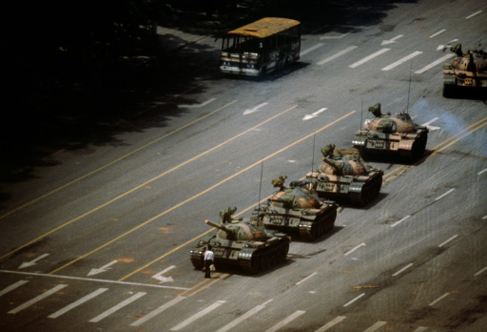
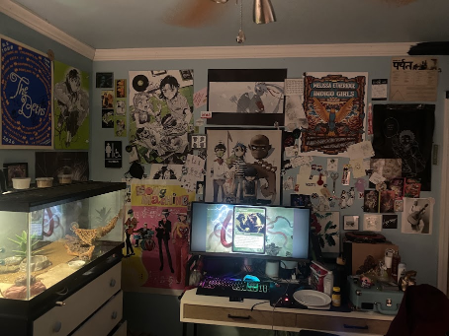
Imagine a lone individual holding shopping bags, standing directly in front of a heavy line of moving military tanks. Now, imagine a quiet bedroom with walls completely blanketed in rock-music posters, anime art, and gaming backgrounds. At first glance, a historic public protest and a teenager’s private bedroom sanctuary seem to share absolutely nothing in common. Yet, both spaces are distinct environments where love and fear meet. While they exist together in a constant psychological handshake, a closer look reveals that fear is merely a secondary reaction. Love is the primary force. Whether on a global stage or within four bedroom walls, humans do not act simply because they are afraid; they act because their love for something gives them the courage to face that fear.
When we look at visual representations of "Love and Fear in Our Communities" in ECE 1007 English, we usually view them as equal, opposing forces pushing and pulling against each other. However, during a reflective interview exploring these themes, the interviewee (a mother) pointed out that these two emotions are deeply twisted together. When she first saw the historic picture of Tiananmen Square's "Tank Man," (Jeff Widener) her immediate reaction was fear, but she quickly recognized that the image is fundamentally about protection and love. When looking at the second picture of the bedroom, she explained that the items on the wall are "an extension of a community that we're part of... and that comforts us." This dialogue shifts the conversation away from seeing love and fear as equal opposites, proving that love is actually the foundation that allows communities to endure external anxieties.
Although love and fear constantly coexist within our lives, love is ultimately the dominant force that wins the 51/49 split. Because of this, individuals use community connections, whether through monumental acts of political resistance or the deliberate curation of personal subcultural sanctuaries, not out of a passive surrender to fear, but as an active, love-driven strategy to conquer it.
Massive political resistance is fundamentally an act of love, not just a reaction to fear. In the interview, the mother noted that it always amazes her when individuals "do seemingly uncomplicated things that are outstandingly brave." Tank Man’s action is not driven by fear of the government, it is driven by a 51% majority of pure love for his people. Love is what creates the bravery needed to stand in front of military machinery.
Personal spaces function as sanctuaries built on love, rather than hiding spots built on fear. A bedroom wall covered in The Guy She Was Interested in Wasn't a Guy at All (Arai), Love Bullet (inee), and JoJo’s Bizarre Adventure (Araki) is a collection of common bonds. This space does not exist to hide from the world out of cowardice. It exists to celebrate the subcultures the teenager loves, proving that love is the active builder of our safe havens.
 Subcultural media provides youth with a blueprint for choosing connection over isolation. The manga The Guy She Was Interested In… is a perfect example. Its plot centers on two girls who overcome social alienation entirely through their shared obsession with rock music. This mirrors exactly what the interview showed, love for a shared passion is the anchor that pulls young people out of the dark cloud of outside fear.
Skeptics might argue that fear is the true winner because it is often the louder, more immediate emotion, like the immediate terror of military tanks or the anxiety of navigating a hostile political climate. They might claim people only build communities because they are terrified of being isolated. However, this view gets the order backward. As the mother beautifully stated in the interview, "You love things and then you would fear them being gone." Fear cannot exist without love existing first. You cannot fear losing a community unless you deeply love that community in the first place. Therefore, fear is just a side effect, while love remains the true root cause and ultimate motivator.
Ultimately, love and fear always exist "in the same space all the time," but love holds the upper hand. “Tank Man” stood in an open street because his love for his community was greater than his fear of the tanks. A teenager lines their walls with art because their love for these stories is stronger than the stressful political world outside. Both actions prove that community is not just a shield against danger, but a monument to what we care about most. For future studies, this leaves us with an inspiring realization: no matter how overwhelming external fear becomes, it will always lose to the quiet, creative, and courageous power of human love.
Thanks to:
My mom for the interview
Me for providing the photo of my room
Jeff Widener for taking the “Tank Man” photograph
Hirohiko Araki for “JoJo’s Bizarre Adventure”
Sumiko Arai for “The Guy She Was Interested In Wasn’t a Guy At All”
inee for “Love Bullet”
Crimson (My Lizard)
Also (Other things present in my picture):
Bands:
The Beths
Gorillaz
John Coltrane
Indigo Girls & Melissa Etheridge
The Police
Misc:
The professor (Tolarian Community College) on PC
Magic The Gathering
Sora Clothing
School of Rock Milford & Madison
Splatoon
Billie Eilish Perfume
The Interview (full transcript):
Interviewer: Okay, this is "Love and Fear in Our Communities." An interview with my mother. This is for question or picture number one. Mother, what does this picture make you feel about love and fear in our communities?
Interviewee: Goodness sakes. I feel like the first thing—my first knee-jerk reaction to the photo—isn't love at all, it's fear. Then for a second, I thought that the bus was a school bus, which amplified the fear, but also intensified the love because potentially, it's like your child is in there. I don't see the tanks as protection necessarily, but I think you could also see them as protection and love—you know, like being there for your country or being there for the people to protect your country.
Interviewer: So, this photo is of a man blocking tanks on their way to Tiananmen Square in China, where there was a bunch of protests against the Chinese Communist Party by students. I don't know the exact proceedings or the background of this photo, but that is what I know. And the man in the photo, known as "Tank Man," would just stand and walk in front of them as they came by. He's holding two shopping bags, like he's just blocking them. They would try to swerve and he would duck in front of them. What do you think about that?
Interviewee: I mean, it always amazes me—the people who stand out and do seemingly uncomplicated things that are outstandingly brave. I think we see that and think, "Oh, yeah, I would stand up for my community like that." But faced with the option, I don't know how many people would actually be brave enough to do it. You know what I mean? So, you think of someone like that in terms of loving their community. Clearly, they're trying. They're speaking volumes by doing something very simple.
Interviewer: Awesome. And now for the second image. Thank you. The second image is from my personal photos. It's a photo of something from me, so you've definitely seen it before and you definitely know what this is. I would like you to maybe pretend like you're not you, and you don't know me, so that you can give your first impression as if you had no preconceived notions. Then we can go more into what you do know about me.
Interviewee: Very familiar image. I didn't mean to smile. Let me see... Okay. So, the first thing I see is obviously somebody's bedroom. I guess I would say it clearly shows the things that are important to this person in their life. Yeah.
Interviewer: All right. And now, knowing that you are you, my mother, and that this is, in fact, my room—what do you think that says about love and fear in our communities?
Interviewee: I'm not sure about the fear part of this, except for the fact that I know I fear for your safety, but that's just my own parental perspective. In terms of looking at the images and whatnot... I guess if I didn't know more about it—to your point, I know what the manga is, and I know why certain signs are on the walls and stuff like that—it would be hard to see some of them from an outside perspective. But I would say for me, obviously, my love is enormous, and seeing all this stuff reminds me of you. And I fear you being out in the community. That's probably where I would go. And also just my frustration with where we're at politically, with a lot of hatred.
Interviewer: What do you think this might say generally about just any teenager, and their pop culture communities?
Interviewee: Like how much you can become part of it, or how much it can mean to you in your everyday life?
Interviewer: Yeah, something like that.
Interviewee: It definitely represents you; it shows all the different things that you're part of, or that make you feel part of a bigger community of people. People who like the magic stuff, the different bands, and the books—things that connect you to your community through a similar, common bond. It could be these things, or in another kid's room, it could be particular sports figures. I think the things that we surround ourselves with are an extension of a community that we're part of, or that we want to be a part of, and that comforts us. So, I think this is very comforting.
Interviewer: Awesome. Thank you so much. Any closing remarks on the whole of it? If you have any correlations? I know they're two very different pictures.
Interviewee: Just for these two? Is there more pictures?
Interviewer: No, just these two.
Interviewee: Well, in general, I would say that we all have a sense of wanting community, and that desire for community is the thing that connects us. That connection is the thing that creates a sense of love. I think the fear of not being connected can be real for a lot of people. Connection is what brings people joy. You can also connect on negative things, but I don't necessarily feel like fear makes you connect. I think connection brings love. You love things, and then you fear them being gone.
Interviewer: Right, exactly. And then you could act because you love something. You could act out of fear of it being harmed, or if you fear something, you act to protect things that you love. I think they obviously go hand-in-hand, even though they're quite opposite. I like that with the first picture, I think he's kind of motivated by both love and fear in the instance. And in the instance of the picture of my room, this is kind of like an escape from fear, being surrounded by the things that I love.
Interviewee: Yeah, I think so. I also think it's interesting how the fear of losing love can make people do crazy things too, or the fear of having it can push it away. It's always a very complicated—as you said—hand-holding of the two. They are such opposites, but they really are in the same space all the time. You love something, you're afraid to lose it. It's kind of what you said. And then being part of your community, fitting in, wanting to be part of a greater whole... it's a big deal.
Interviewer: Well, thank you again so much.
Interviewee: Thanks for asking me.
Interviewer: Quite an excellent interview.